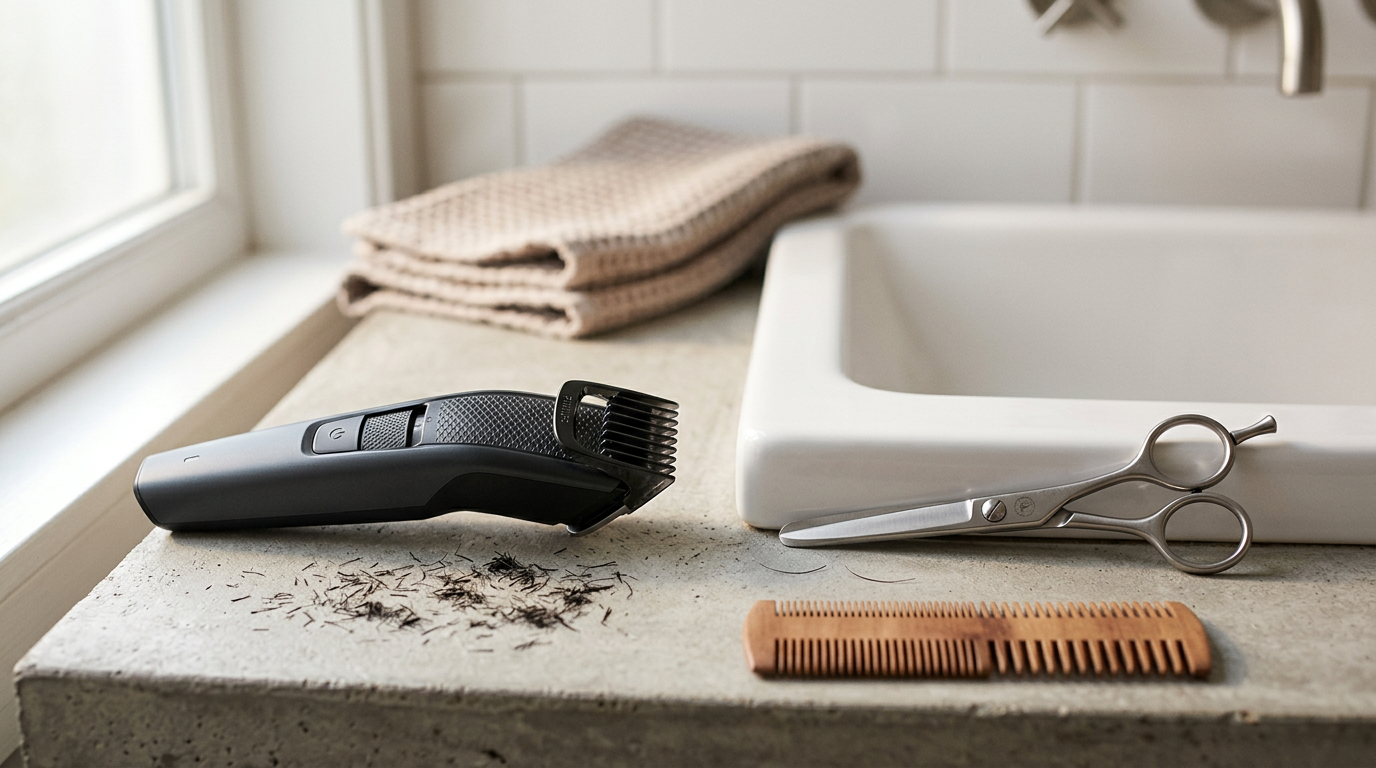
A beard trimmer and beard scissors can both shorten facial hair, but they solve different problems. A trimmer is best when you want repeatable length across an area. Scissors are better when you need to remove a few projecting hairs without changing the overall shape.
Bottom line: Use a guarded trimmer for bulk reduction and even maintenance. Use scissors for selective correction, mustache control, and details that a powered cutter would remove too broadly.
Match the tool to the amount of hair you need to remove
| Task | Better starting tool | Why |
|---|---|---|
| Reduce a full beard by one level | Guarded trimmer | The guide controls the cutting distance across a large area. |
| Remove a few isolated long hairs | Scissors | You can cut only the strands that break the outline. |
| Shorten a mustache near the lip | Scissors or a narrow detail trimmer | The working area is small and visibility matters. |
| Create an even short beard | Guarded trimmer | Repeated passes with one setting are easier to reproduce. |
| Change the beard shape substantially | Trimmer first, scissors second | Bulk removal and detail correction are separate jobs. |
The key distinction is coverage. A trimmer removes many hairs that enter the blade path. That speed is useful, but it also means a mistaken setting or pass can affect an entire section. Scissors work one small cut at a time. They are slower, but the consequences of each cut are easier to contain.
When a trimmer is the practical choice
Choose a trimmer when consistency matters more than strand-by-strand control. This includes keeping facial hair short, trimming a longer beard before refining the outline, or repeating a known length every week or two.
If you’re uncertain, start with a guard longer than your intended result. You can shorten more; you cannot replace hair removed by an unexpectedly short setting.
- Confirm the guard is fully seated and the length control is locked, if the model has an adjustable dial.
- Work on dry hair unless the manufacturer specifically permits and instructs another method. Hair can sit differently when wet.
- Make the first pass in a less prominent area, then check the result in normal light.
- Use overlapping passes without pressing hard enough to flex the guard against the skin.
- Brush or comb the beard, then re-evaluate before lowering the setting.
The direction of cutting changes how much hair reaches the blade. Moving against the grain usually captures more hair than moving with it. Treat a direction change as a more aggressive step, even when the guard number stays the same.
Where scissors give you better control
Use scissors when the beard is mostly right and only a few hairs are wrong. Comb or brush the hair into place first. Then cut the strand that extends beyond the desired outline rather than cutting deep into the beard. For mustache work, keep the blade tips visible and make small cuts; don’t trim while walking, rushing, or looking in a poorly placed mirror.
Use grooming scissors with clean, undamaged blades and a size you can control. Large household scissors make close facial work harder. Dull blades may push or fold hair instead of cutting cleanly.
A two-tool workflow prevents overcorrection
For a beard that has grown beyond its usual shape, remove bulk with the longest useful trimmer guard, comb the hair, reassess the outline, and use scissors only on remaining projections. This separates the broad length decision from the detail decision. Trying to perfect every contour with a trimmer often leads to repeated passes and an unintended shorter result.
What if the beard has curls or uneven density?
Do not assume every area should be cut to the same visual depth. Curly sections can spring back after trimming, and lower-density areas may look shorter at the same numerical setting. Make conservative passes, let the hair settle, and adjust by appearance rather than chasing identical cutting time on each side.
Work through one mixed-tool trim
Consider a beard that is generally at the right length but has grown beyond its usual outline around the chin and mustache. Starting with scissors would require many individual judgments, while taking an unguarded trimmer across the area could lead to one broad mistake.
The controlled sequence is to comb the beard into place, attach a guard that cannot remove more length than intended, and reduce only the uniformly overgrown areas.
After that broad pass, stop and rearrange the hair. If the remaining problem is a few strands extending beyond the outline, grooming scissors become the better tool.
If an entire region still sits farther out than intended, repeat with the same guard before considering a shorter one. The decision depends on the size of the correction, not on which tool is inherently more advanced.
When neither tool should be used immediately
Pause if the guard is cracked, the blade pulls hair, the scissors are loose or damaged, visibility is poor, or the skin is painful, broken, or actively irritated. Tool choice cannot compensate for unsafe equipment or an area that should not be groomed.
- For the earlier shaving-tool decision, see Electric Shaver vs Manual Razor: Which Fits Your Routine?.
- If you haven’t established a full beard routine yet, start with How to Build a Basic Beard-Grooming Routine.
Check the result before making another pass
Step away from the mirror, change the lighting, and view the beard from the front and both sides. Comb it once more. If the remaining issue is one or two hairs, switch to scissors. If a whole region is still longer, stick with the same guard before going shorter. That pause is the simplest protection against turning a small correction into a complete reset.
Once you’ve chosen a tool for the job, use the beard-grooming checklist to walk through trimming, checking the shape, and cleaning up.